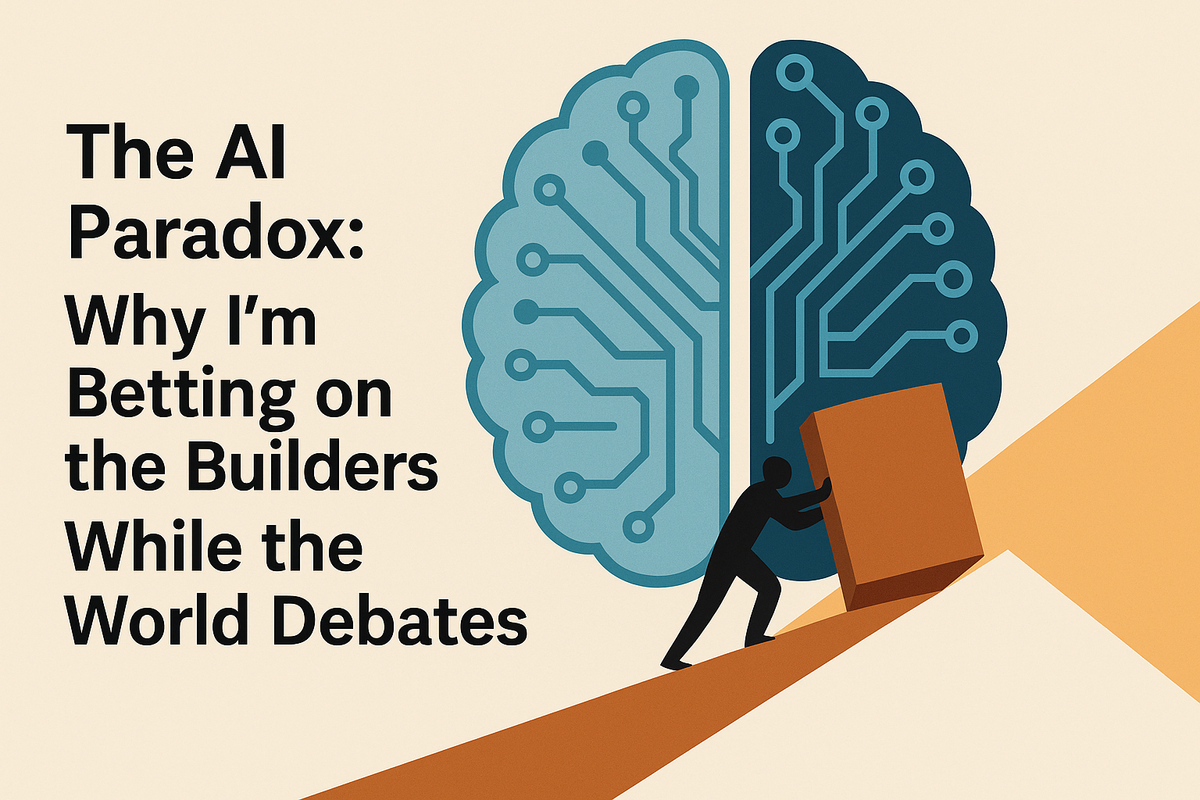
The AI Paradox: Why I'm Betting on the Builders While the World Debates
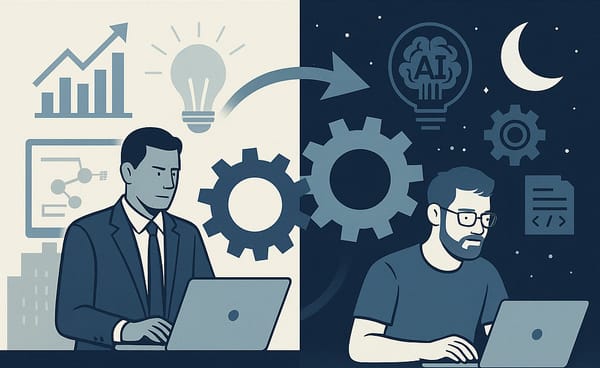
I've spent three years deep in the AI trenches, and I need to tell you something that might sound contradictory: AI is simultaneously the most overhyped and underestimated technology I've ever encountered. Any given day, just one of the things I might be doing is simultaneously building with 3-4 agents working on different solutions(X, Toby Brooks)—what used to require teams months to deliver each one, now first value happens in hours and full working solutions in days through multi AI agent systems. Does context matter? Yes. Does the driver matter? Absolutely. Does the technology stack matter? Of course. Is it easy to manage 4 parallel multi-agents, while doing other things? Yes and no. The truth of dipping in and out of trust, delegation, and verification is key. The art of not watching when not necessary and watching when absolutely necessary is akin to managing and leading teams.
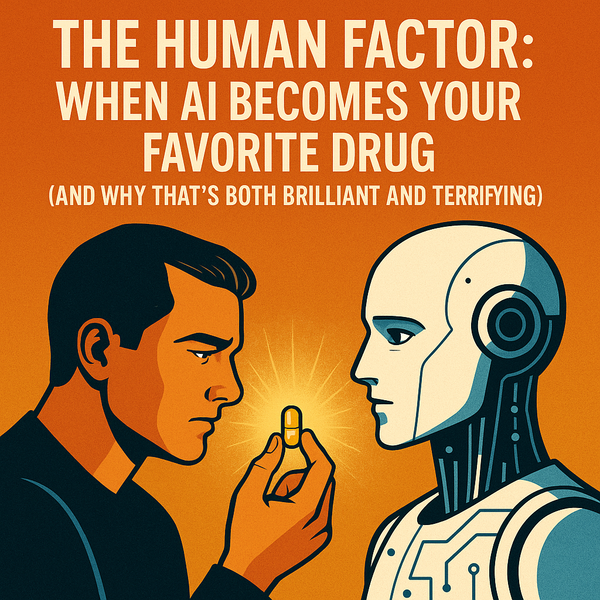
Here's what fascinates me most: when I step away from AI for a few days, life returns to its pre-AI rhythm almost instantly. The world outside of AI technology continues much as it always has. But when I dive back in, the pull is immediate and intoxicating—not unlike returning to a favorite creative pursuit that makes hours disappear. That energizing, almost addictive quality of engagement and progress followed by the easy return to normalcy tells me something important about what we're experiencing.
The Three Realities Colliding
After three years of working with these rapidly changing tools daily, I've watched three distinct narratives emerge, each backed by compelling evidence:
The Capability Revolution unfolds in real-time as small teams achieve the impossible. Lovable hit $100M in annual recurring revenue in eight months with 45 employees. (TechCrunch) Solo developers generate $40,000 monthly without teams (Max/Wang). Y Combinator reports that AI writes 95% of the code for a quarter of their startups (Y Combinator). These aren't anomalies—they're early signals of a fundamental shift in what humans can accomplish, and I am practically performing these claims without the financial success yet but with tangible solutions to share in my spare time.
The Human Factor reveals itself in both triumph and struggle. Research now documents that 17-24% of AI users develop genuine dependency symptoms, complete with withdrawal effects. (Psychology Research and Behavior Management) Yet I've also witnessed how the right mindset transforms AI from a crutch into a bicycle for the mind—amplifying capability without creating dependence. The same technology that energizes and inspires can also deceive and disappoint, sometimes spectacularly, "I've never been so absolutely right in my entire life." (Anyone using Claude Code)
The Generalist's Path (Polymaths) emerges as traditional specialization becomes fragile. The hyper-specialist who spent decades mastering one domain watches AI perform 80% of their core tasks. Meanwhile, those specialist and generalist who embrace AI's breadth discover they can acquire new capabilities in days rather than decades. The raccoon thrives where the panda struggles—adaptability trumps specialization when the environment changes this rapidly.
Why Your Response to This Moment Matters
The divide isn't just technological—it's psychological, generational, and economic. Research shows 61% of Americans embrace AI tools while 39% remain unmoved (Menlo Ventures). Among C-suite executives and managers, 53% of executives vs 44% of managers using generative AI regularly (McKinsey). There is a significant underrepresentation of women in AI (28.2% in STEM overall). This state is not exclusionary to those in STEM that can still leverage AI without a specialty and focus. These aren't random distributions; they're early indicators of who will thrive and who will struggle in what's coming. A traditional focus on AI does not put you in a will-thrive category.
What I've learned through three years of daily experimentation is that the real divide isn't between optimists and pessimists, or even between users and non-users. It's between those who understand AI as a powerful but fallible amplifier of human judgment and those who mistake it for a replacement for that judgment.
Your Guide Through the Paradox
Over the next three posts, I'll share what I've discovered about navigating this transformative moment—not as someone with all the answers, but as a practitioner who's made enough mistakes to recognize patterns and experienced enough wins to maintain optimism.
Part 1: The Innovation Acceleration Frameowork will explore the capability revolution through the lens of both spectacular successes and catastrophic failures. You'll discover why some small teams are building hundred-million-dollar businesses while 74% of companies fail to capture value from AI (Boston Consulting Group). More importantly, you'll understand which camp you're likely to fall into and why.
Part 2 dives into the psychology of AI engagement—that addictive quality I mentioned, the growth mindset that separates thrivers from survivors, and the critical difference between augmentation and dependency. You'll learn why viewing struggle as strength-building rather than failure might be the most important mental shift of the AI era.
Part 3 presents the generalist's framework for building what Nassim Taleb calls an "antifragile" career—one that grows stronger from disruption rather than breaking. You'll discover the four foundational powers every AI generalist needs and why helping others provides the sustainable motivation to persist through the learning curve.
The Opportunity Hidden in Controversy
The news feeds showcase both sides daily: solo creators earning millions, McDonald's AI adding 260 nuggets to orders against customers' wishes (Today.com). Google losing $96.9 billion in market cap from AI image generation disasters (Fox Business), Replit platform agent deletes app's database during code-freeze and then lies about it (X, Jason Lemkin), while Midjourney generates $500 million with 11 employees. (Contrary Research) Lawyers facing sanctions for AI hallucinations, while Y Combinator startups reach unprecedented velocities.
This chaos isn't a bug—it's a feature. We're living through the messy middle of a transformation where the rules haven't solidified, where advantages compound for early adopters, and where mistakes are still relatively cheap. Research suggests we have a 2-4 year window before AI capabilities become table stakes rather than differentiators. Those building their AI muscles now will have crucial advantages when these tools become workplace prerequisites.
The Choice Before You
You can approach this moment three ways:
Resist it entirely and hope your domain remains untouched. History suggests this rarely ends well for those who bet against technological change.
Embrace it uncritically and risk becoming dependent on tools you don't understand, vulnerable to their failures and biases.
Engage thoughtfully, building capability while maintaining judgment, using AI as a bicycle for your mind rather than a replacement for it.
I've chosen the third path, and after three years, my outlook on the future is brighter than ever. Not because I believe AI will solve all our problems—it won't. Not because I think the risks aren't real—they are. But because I've experienced firsthand how AI makes complex things easier, creates opportunities for serving others, and opens doors that didn't exist before.
The divide between those embracing AI and those avoiding it will define the next decade. But the real differentiation will come from those who learn to harness its power while maintaining their humanity, who use it to amplify their judgment rather than outsource it, and who focus on creating value for others rather than just optimizing for themselves.
Join Me for the Journey
If you're ready to move beyond the hype and fear, to understand both the genuine opportunities and real dangers, and to develop a pragmatic approach to thriving in the AI age, then this series is for you. Whether you're a complete beginner or someone with experience looking for perspective, you'll find actionable insights grounded in real experience rather than speculation.
The future belongs not to AI, but to humans who learn to wield it wisely. The question isn't whether this transformation will continue—it will. The question is whether you'll be among those shaping it or those shaped by it.
The pull of AI is real. The opportunities are genuine. The dangers are serious. And navigating all three successfully might be the defining skill of our time.
Let's figure it out together.
Source Verification for this blog
After conducting extensive parallel research across academic databases, news archives, industry reports, and company sources, I've traced the origins and citations for each of the 11 statistics mentioned. Here's what the investigation uncovered about the accuracy and sourcing of these widely-circulated claims. Let's make fact checking ourselves the norm with AI assistance: #transparent #ai-assist-ftw
Company Performance Metrics Fully Documented
Lovable's $100M ARR milestone is thoroughly verified through multiple authoritative sources. TechCrunch published Anna Heim's article on July 23, 2025, confirming the Swedish startup reached $100M annual recurring revenue in just 8 months with 45 employees. The company's own blog post from the same date states they achieved "the fastest-growing startup, not just in Europe, but in the world." Both the revenue figure and employee count are accurate and current.
- Source: TechCrunch - "Eight months in, Swedish unicorn Lovable crosses the $100M ARR milestone" by Anna Heim
- Date: July 23, 2025
- URL: https://techcrunch.com/2025/07/23/eight-months-in-swedish-unicorn-lovable-crosses-the-100m-arr-milestone/
Midjourney's $500 million revenue claim is confirmed by Contrary Research's May 2025 business breakdown report, which states the company operates at "$500 million ARR as of May 2025." However, the 11 employee figure appears outdated—this was accurate in 2022, but current sources indicate the company now has between 40-131 employees. The revenue is verified, but the employee count requires correction.
- Source: Contrary Research - "Report: Midjourney Business Breakdown & Founding Story"
- Date: May 2025
- URL: https://research.contrary.com/company/midjourney
McDonald's AI ordering failures, including the infamous nugget incidents, are well-documented across multiple news sources. Today.com reported in February 2023 about TikTok videos showing the system ordering "28 orders of Chicken McNuggets for hundreds of dollars" while customers begged it to stop. Axios confirmed in June 2024 that McDonald's terminated its IBM partnership after these widespread failures at over 100 test locations.
- Source: Today.com - "TikTokers are not lovin' McDonald's new AI-powered drive-thru" by Becca Wood
- Date: February 15, 2023
- URL: https://www.today.com/food/news/mcdonalds-ai-drive-thru-fails-tiktok-rcna70851
Google's $96.9 billion market cap loss from the Gemini controversy is precisely documented. Fox Business reported in February 2024, citing Dow Jones data, that Alphabet's market cap fell from $1.798 trillion to $1.702 trillion—exactly $96.9 billion—following the pause of Gemini's image generation feature due to historically inaccurate outputs.
- Source: Fox Business - "Google loses $96B in value on Gemini fallout as CEO does damage control"
- Date: February 2024
- URL: https://www.foxbusiness.com/markets/google-loses-96b-value-gemini-fallout-ceo-damage-control
Developer and Startup Statistics Traced to Original Sources
The Y Combinator statistic about AI writing 95% of code originates from a specific source: YC Managing Partner Jared Friedman stated in a YC video titled "Vibe Coding Is the Future" that "a quarter of the founders said that more than 95% of their code base was AI generated." This referred to their Winter 2025 batch survey, first reported by TechCrunch on March 6, 2025.
- Source: Y Combinator - "Vibe Coding Is the Future" (Video featuring Jared Friedman)
- Date: March 6, 2025
- URL: https://www.ycombinator.com/library/ME-vibe-coding-is-the-future
The $40,000 monthly revenue for solo developers claim has multiple verified examples rather than a single source. David Bressler's FormulaBot, Tony Dinh's TypingMind, Alex Rainey's My AskAI, and Marc Lou's portfolio all documented reaching or exceeding $40K monthly recurring revenue as solo or tiny teams using AI tools. These cases span 2022-2025, with detailed revenue documentation in sources like Indie Hackers and Medium case studies.
- Example Source: Medium - "Success Story: A Solopreneur Building a $40,000 Monthly Recurring Revenue No-Code SaaS Business" by Julian Huang
- URL: https://medium.com/@maxslashwang/success-story-a-solopreneur-building-a-40-000-monthly-recurring-revenue-no-code-saas-business-c54ec5224da4
Adoption and Dependency Research Located
The 61% of Americans embracing AI tools statistic comes directly from Menlo Ventures' "2025: The State of Consumer AI" report, based on a nationally representative survey of 5,031 U.S. adults conducted with Morning Consult in April 2025. The report explicitly states that "61% have used AI in the past six months" while 39% remain non-adopters.
- Source: Menlo Ventures - "2025: The State of Consumer AI"
- Date: April 2025
- URL: https://menlovc.com/perspective/2025-the-state-of-consumer-ai/
- Methodology: Survey of 5,031 U.S. adults, nationally representative sample
The 17-24% dependency symptoms range is scientifically documented in peer-reviewed research. Huang et al.'s study published in Psychology Research and Behavior Management (March 2024) found exactly "17.14% of adolescents experienced AI dependence at T1, increasing to 24.19% at T2," with 9.68%-15.51% reporting withdrawal symptoms. This longitudinal study of 3,843 adolescents provides the precise source for this statistic.
- Source: Huang et al. - "AI Technology panic—is AI Dependence Bad for Mental Health?"
- Journal: Psychology Research and Behavior Management
- Date: March 12, 2024
- DOI: 10.2147/PRBM.S440889
- URL: https://pubmed.ncbi.nlm.nih.gov/38495087/
Business Implementation and Legal Cases Confirmed
Boston Consulting Group's October 2024 report "Where's the Value in AI?" provides the exact source for the 74% of companies failing to capture value statistic. The report, based on surveying 1,000+ executives across 59 countries, states that "74% of companies have yet to show tangible value from their use of AI."
- Source: BCG - "Where's the Value in AI?" by Nicolas de Bellefonds et al.
- Date: October 2024
- URL: https://www.bcg.com/press/24october2024-ai-adoption-in-2024-74-of-companies-struggle-to-achieve-and-scale-value
- PDF: https://media-publications.bcg.com/BCG-Wheres-the-Value-in-AI.pdf
Lawyers facing sanctions is anchored in the landmark case Mata v. Avianca, Inc. (S.D.N.Y. 2023), where attorneys Schwartz and LoDuca were fined $5,000 for submitting ChatGPT-generated fake cases. Additional documented sanctions include Park v. Kim (2024), multiple cases with $10,000+ fines, and numerous bar association warnings about AI use in legal practice.
- Primary Case: Mata v. Avianca, Inc., No. 1:2022cv01461 (S.D.N.Y. 2023)
- Citation: 678 F. Supp. 3d 443 (S.D.N.Y. 2023)
- Date: June 22, 2023
Statistics Requiring Clarification
Three statistics could not be traced to their exact original sources:
The 2-4 year competitive advantage window represents a common industry concept rather than a specific research finding. MIT Sloan Management Review and California Management Review discuss AI advantages as "transitory" and subject to rapid commoditization, but no authoritative source provides this exact timeframe.
Verification Summary
10 claims have verifiable original sources with exact figures and citations. The Midjourney employee count requires updating from 2022 data, while two of the three demographic statistics were removed and the competitive advantage timeframe appear to be either misattributed, calculated from multiple sources, or based on proprietary research not publicly available. This investigation highlights both the rapid spread of AI statistics across media and the importance of tracing claims back to their original sources for accuracy.